Urban Mobility Portfolio Committee’s take on 2022
12 December 2022
The City of Cape Town’s Urban Mobility Portfolio Committee has been
working to ensure that Cape Town’s road infrastructure, along with its
transport network, continues to deliver on its service delivery mandate to
residents and to ensure the safety of all road users.
'Accountability is critical for our country. In the City of Cape Town, we place this tenet front and centre in all that we do. It is in light of this that I wanted to share a summary of the Urban Mobility Portfolio Committee's work for 2022.
'As a committee, we have spent the year trying to build a sense of bipartisan teamwork to fulfil our oversight role and contribute towards making Cape Town a City of Hope for South Africa.
'Our portfolio committee focuses on City-wide issues, projects, and programmes while being part of the broader team of subcouncils, ward and proportional representative councillors. We have sought to ensure that critical information such as traffic calming requests are shared with subcouncils. I'd like to remind the public that portfolio committee sittings are open to members of the public to observe our proceedings; and that all reports are available online,' said Councillor Mikhail Manuel, the Chairperson of the Urban Mobility Portfolio Committee.
The Urban Mobility Directorate's priorities over the past year have been focused on:
· Restoring the MyCiTi N2 Express service
· The infrastructure roll-out needed for the second phase of the MyCiTi service to the metro south-east to link Khayelitsha and Mitchells Plain to Wynberg and Claremont
· Improving the quality and safety of our road network
· Investing in non-motorised transport routes to make travel safer for pedestrians and cyclists
· Lobbying for the devolution of Cape Town's passenger rail service
The Urban Mobility Portfolio Committee considered 98 reports and presentations, undertook nine workshops, and conducted oversight visits of non-motorised transport projects in Salt River, a public transport interchange in Makhaza, inspected the quality of roads and winter readiness challenges in Khayelitsha, and visited the Roads and Infrastructure Maintenance Depot in Ndabeni, Pinelands.
'Looking back over 2022, I am excited by the progress we are making in our Urban Mobility space. While much still remains to be done, the Urban Mobility Directorate has made significant progress in meeting these goals. The N2 Express service has been restored, and the Phase 2A project is progressing well, which includes the construction of the Sky Circle on the corner of Jan Smuts Drive and Govan Mbeki Road. We have also continued with our innovative road maintenance programme to improve the quality of our road network under tight budgetary constraints,' said Councillor Rob Quintas, the City's Mayoral Committee Member for Urban Mobility.
Traffic Calming Projects
Residents across Cape Town want calmer and safer streets in their neighbourhoods. This is evident by the sheer volume of traffic calming requests and approved projects in the directorate. The portfolio committee requested each subcouncil to provide a quarterly list of all requested, denied, and approved traffic calming projects. Our Policy Review Working Group has also undertaken to review the traffic calming policy to include the lessons learnt since its 2017 inception.
Urban Mobility Development Charges
Every opportunity to improve the quality of roads in Cape Town should be explored. It is in this vein that the Portfolio Committee has closely monitored potential Urban Mobility projects funded from development charges to aid congestion relief, and improve the quality of roads. We are looking forward to seeing significant infrastructure improvements.
City-wide NMT programme
Cape Town is a walking city. Thousands of people walk every day between home, public transport interchanges, and work. This last mile link is key to encouraging motorists to shift to public transport. The portfolio committee took a keen interest in the next phase of NMT investment - Phase Four. Feedback on lessons learnt from Phase Three and innovations that could be employed to attract more users to walking and cycling are being reviewed. The recently installed 'Rainbow Crossing' in De Waterkant and the public art crossing in Sea Point are good examples of what can be done elsewhere across Cape Town.
Other highlights:
· Signing of service level agreement with Sanral to enable repair of signalling at road crossings, at their cost
· Transfer of various roads from Provincial Government
· Piloting of thermal sensor technology at a pedestrian crossing
'Vandalism and dumping also continue to affect our stormwater infrastructure and cause untold misery for surrounding households.
'We have to improve on our backlog in terms of road resurfacing, whether they be due to reinstatements or potholes, and I am hopeful that our additional funds in the last half of the 2022/3 financial year as well as new long-term tenders that we are hoping to implement in the 2023/24 financial years, will go a long way to addressing these matters.
'These issues represent some of the key challenges faced by the communities of Cape Town. Of course, time is limited each year so, unfortunately, the committee can only undertake a limited number of oversight tasks. In the back of our minds, we always reflect on whether an issue will help to shift the needle for better mobility for the whole of Cape Town,' said Councillor Quintas.
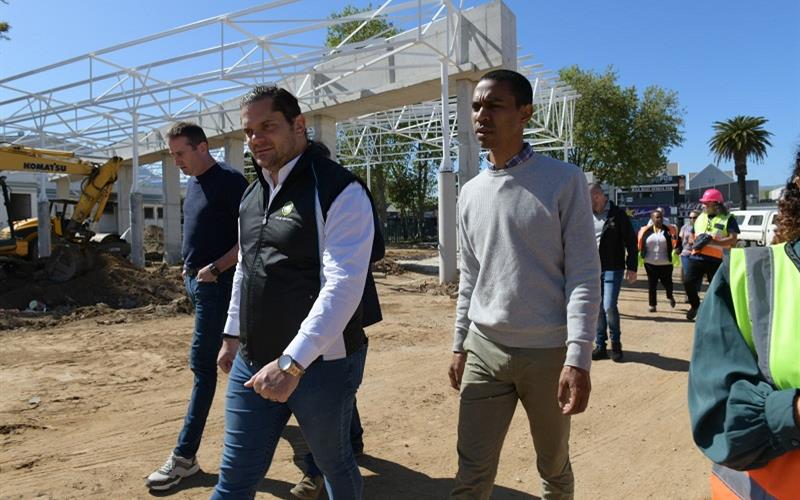
Caption: The City's Urban Mobility Portfolio Committee conducted a number of site visits during 2022 to monitor the progress with ongoing projects. In October, as part of Transport Month, the members joined Councillor Rob Quintas when they visited the construction site of the new public transport interchange in Somerset West. Councillor Mikhail Manuel (in the grey jersey), Chairperson of the Portfolio Committee, is walking next to Councillor Quintas.
End
Published by:
City of Cape Town, Media Office